
Currently Empty: € 0,00
Back to: 1.2 Aircraft and flight crews
0
Various types of aircraft are used in medical evacuation (medevac) or air ambulance services, each chosen based on the specific needs of the mission, including the distance to be covered, the condition of the patient, and the available infrastructure. Here are some common types of aircraft used in medevac:
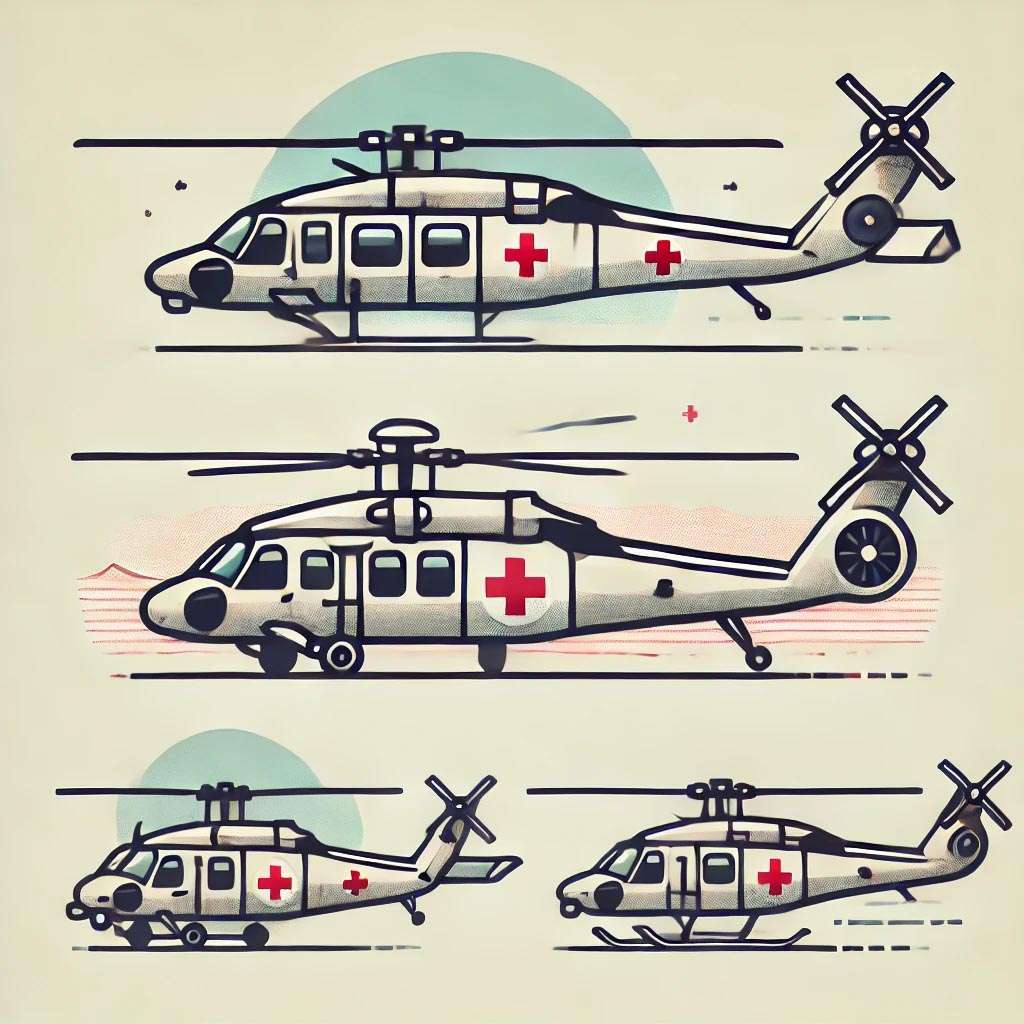
- Helicopters:
- Light Utility Helicopters: These are small, versatile helicopters that can land in confined spaces, making them suitable for emergency medical evacuations in urban or remote areas.
- Medium-Lift Helicopters: Larger helicopters with more capacity, allowing for the transportation of medical teams and additional equipment.
- Fixed-Wing Aircraft:
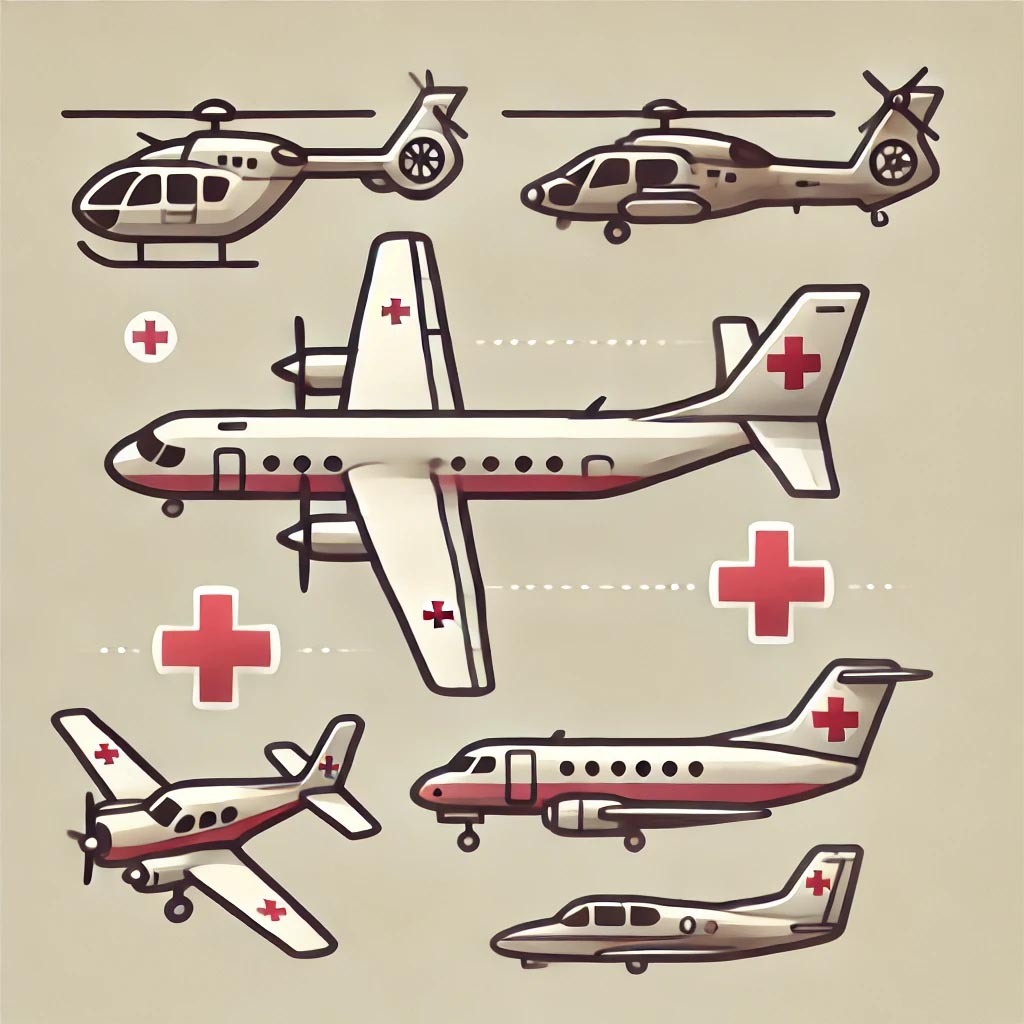
- Turboprop Aircraft: These aircraft, such as King Air or Pilatus PC-12, are capable of short takeoffs and landings, making them suitable for reaching airports with shorter runways.
- Jet Aircraft: Larger and faster than turboprops, jet aircraft like Learjet or Citation series are used for long-distance medical evacuations.
- Specialized Air Ambulance Jets:
- Air Ambulance Jets: Some companies operate dedicated air ambulance jets that are fully equipped with medical facilities, including an intensive care unit. These are often used for long-distance international evacuations.
- Military Aircraft:
- Medevac Helicopters: Military helicopters are often used for evacuating wounded soldiers from the battlefield. They are equipped to provide critical care during transport.
- Medevac Fixed-Wing Aircraft: Military cargo planes can be adapted for medical evacuations, allowing for the transport of multiple patients over longer distances.
- Amphibious Aircraft:
- Amphibious Aircraft: In regions with numerous bodies of water, amphibious aircraft can be used to access areas that are difficult to reach by other means.
The choice of aircraft depends on factors such as the urgency of the situation, the distance to be covered, the medical needs of the patient, and the available infrastructure at both the departure and arrival locations. Each type of aircraft has its advantages and limitations, and medical teams work to select the most appropriate option for each specific medevac mission.
Aircraft and Flight Crews:
In most jurisdictions, air ambulance pilots must possess extensive experience in piloting their aircraft due to the challenging conditions of air ambulance flights compared to regular non-emergency flight services. After a surge in air ambulance crashes in the United States during the 1990s, the U.S. government and the Commission on Air Medical Transportation Systems (CAMTS) enhanced accreditation and air ambulance flight requirements. This ensured that pilots, personnel, and aircraft meet significantly higher standards than before.
The resulting CAMTS accreditation, applicable only in the United States, mandates air ambulance companies to own and operate their own aircraft. However, recognizing the difficulty of having the correct medicalized aircraft for every mission, some air ambulance companies instead charter aircraft based on mission-specific requirements.
Although CAMTS accreditation is theoretically voluntary, several government jurisdictions mandate companies providing medical transportation services to have CAMTS accreditation to be licensed to operate. This is a growing trend as state health services agencies address safety concerns related to emergency medical services flights. Some states requiring CAMTS accreditation include Colorado, New Jersey, New Mexico, Utah, and Washington. CAMTS accreditation provides assurance that the service meets national public safety standards, and compliance is continually checked by the accrediting organization.
In the UK, the Association of Air Ambulance (AAA) has a Code of Conduct that binds fundraising standards, CAA/EASA regulations, and the CQC together. This ensures that fundraising, air operations, and clinical operations align with national regulations and best practices.
Medical Control:
The nature of the air operation often determines the type of medical control required. In many cases, air ambulance staff are more skilled than typical paramedics, granting them greater medical decision-making latitude. Their assessment skills are higher, allowing functions like reading x-rays and interpreting lab results. This expertise enables planning, consultation with supervising physicians, and issuing contingency orders during flight.
Some systems operate predominantly offline, using protocols for most procedures and seeking online medical control only when protocols are exhausted. Air ambulance operations may have full-time, on-site medical directors with relevant backgrounds (e.g., emergency medicine), or medical directors who are available only by pager. Systems operating on the Franco-German model often have a physically present physician, making medical control less of an issue. This diverse approach accommodates the varied needs and structures of air ambulance services worldwide.
Equipment and Interiors:
Most air ambulances, excluding charter and some military aircraft, are equipped for advanced life support, reflecting their role in providing critical medical care during transit. However, there are challenges, particularly in helicopters, due to high ambient noise levels and limited working space, which can hinder ongoing care provision. Despite having high-level and conveniently grouped equipment, certain assessment procedures may be challenging during flight, and not all areas of the patient may be physically accessible. Pressurization is another consideration, as not all air ambulances have pressurized cabins, and those that do are typically pressurized to 10,000 feet above sea level, requiring advanced knowledge of aviation medicine.
A variety of helicopter makes are used for civilian Helicopter Emergency Medical Service (HEMS) models, including Bell 206, 407, 429, Eurocopter AS350, BK117, EC130, EC135, EC145, Agusta Westland 109, 169, 139, MD Explorer, and Sikorsky S-76. Fixed-wing aircraft varieties commonly include Learjet 35, 36, 31, King Air 90, King Air 200, Pilatus PC-12, PC-24, and Piper Cheyenne. Due to medical crew and patient compartment configurations, these aircraft are usually set up to transport one patient, but some can be configured for two if needed. Helicopters have stricter weather minimums and typically do not operate at altitudes over 10,000 feet above sea level.
Challenges:
Starting in the 1990s, there was a notable increase in air ambulance crashes in the United States, particularly involving helicopters. By 2005, the number had reached a record high, prompting concerns. These crashes, often deemed acceptable due to the nature of air ambulance operations operating on the edge of safety envelopes for life-saving missions, resulted in nearly fifty percent of all EMS personnel deaths in the U.S. occurring in air ambulance crashes. The United States National Transportation Safety Board (NTSB) concluded in 2006 that many of these crashes were avoidable, leading to improved government standards and CAMTS accreditation.
Cost-Effectiveness:
While some air ambulances have effective funding methods, in England, they are primarily charity-funded, as improved cost-benefit ratios are generally achieved with land-based attendance and transfers. The cost-effectiveness of air ambulances, especially in comparison to ground transportation, remains uncertain.
Patient Survival vs. Ground Ambulance:
Patient outcomes are a primary measure of effectiveness in the United States, and improvements in ground ambulance prehospital care have raised questions about the superiority of helicopter emergency medical services transport. Studies have shown mixed results, with some indicating better survival rates for trauma patients transferred by helicopter. Patient survival is not the only measure, and various outcome measures may be applicable based on the medical condition.
Dispatch of Air Medical Services vs. Ground Ambulance:
Determining whether to dispatch air medical services involves considering factors such as availability, distance, flight conditions, and the speed of response. Ground ambulances may be more numerous and closer to the scene, departing more quickly than air ambulances. However, air ambulances are advantageous in congested ground access routes and for locations distant from hospitals. Situational considerations may lead to dispatching both ground and air ambulances for optimal patient care.
Personnel:
- Retrieval Doctor/Physician: Criteria for working as a retrieval doctor/physician vary by jurisdiction. In Australia, retrieval doctors must have experience in a critical care specialty or be specialty registrars in advanced training.
- Flight Paramedic: Licensed paramedic with additional training as a certified flight paramedic (FP-C) or a master’s degree. Highly trained with significant experience in pre-hospital emergency medicine and critical care transport.
- Flight Nurse: Specialized nurse in patient transport in the aviation environment, providing in-flight management and care. May hold certifications in Emergency Nursing (CEN), Flight Nursing (CFRN), or Critical Care (CCRN).
Transport Respiratory Practitioner:
Highly trained respiratory practitioner (respiratory therapist) used in long-distance transport situations. May obtain certifications such as Adult Critical Care Specialist (ACCS), Neonatal Transport Specialist (NPT), and Neonatal Pediatric Specialist (NPS).
Recommended References
- Borne, M., Tourtier, J. P., Ramsang, S., Grasser, L., & Pats, B. (2012). Collective air medical evacuation: the French tool. Air medical journal, 31(3), 124-128.
- Guénot, P., Beauchamps, V., Madec, S., Carfantan, C., Boutonnet, M., Bareau, L., … & Travers, S. (2019). Fixed wing tactical aircraft for air medical evacuation in Sahel. Air Medical Journal, 38(5), 350-355.
- Grebenyuk, A. N., Lisina, E. A., Lisin, P. L., & Starkov, A. V. (2020). Medical technical devices for medical evacuation of wounded and injured in emergency situations. Medicо-Biological and Socio-Psychological Problems of Safety in Emergency Situations, (1), 21-35.
- Beebe, M., & Ret, C. (2013, October). Unmanned aircraft systems for casualty evacuation: what needs to be done. In Proceedings of the NATO STO-MP-HFM-231 Symposium, Beyond Time and Space.
- Hudson, F. L. M. (1918). A History of military Aeromedical Evacuation. REVIEW, 74.
- Biswal, P. (2019). Cas/Medevac in field area: an experience and lessons drawn. Indian Journal of Aerospace Medicine, 63(1), 33-38.
- Biswas, S., Turan, H., Elsawah, S., Richmond, M., & Cao, T. (2023). The future of military medical evacuation: literature analysis focused on the potential adoption of emerging technologies and advanced decision-analysis techniques. The Journal of Defense Modeling and Simulation, 15485129231207660.
- Cunningham, C. W., Keen, D. E., Schauer, S. G., Kharod, C. U., & De Lorenzo, R. A. (2019). Military Casualty Evacuation: MEDEVAC. Aeromedical Evacuation: Management of Acute and Stabilized Patients, 21-40.
- Hurd, W. H., & Jernigan, J. G. (Eds.). (2003). Aeromedical evacuation. Springer.
- Thomas, R. E., & TEXAS ENGINEERING EXPERIMENT STATION COLLEGE STATION. (1985). The Use of the Civil Reserve Air Fleet in Evacuation of Battlefield Casualties: An Evaluation (p. 0086). Texas A & M University.